
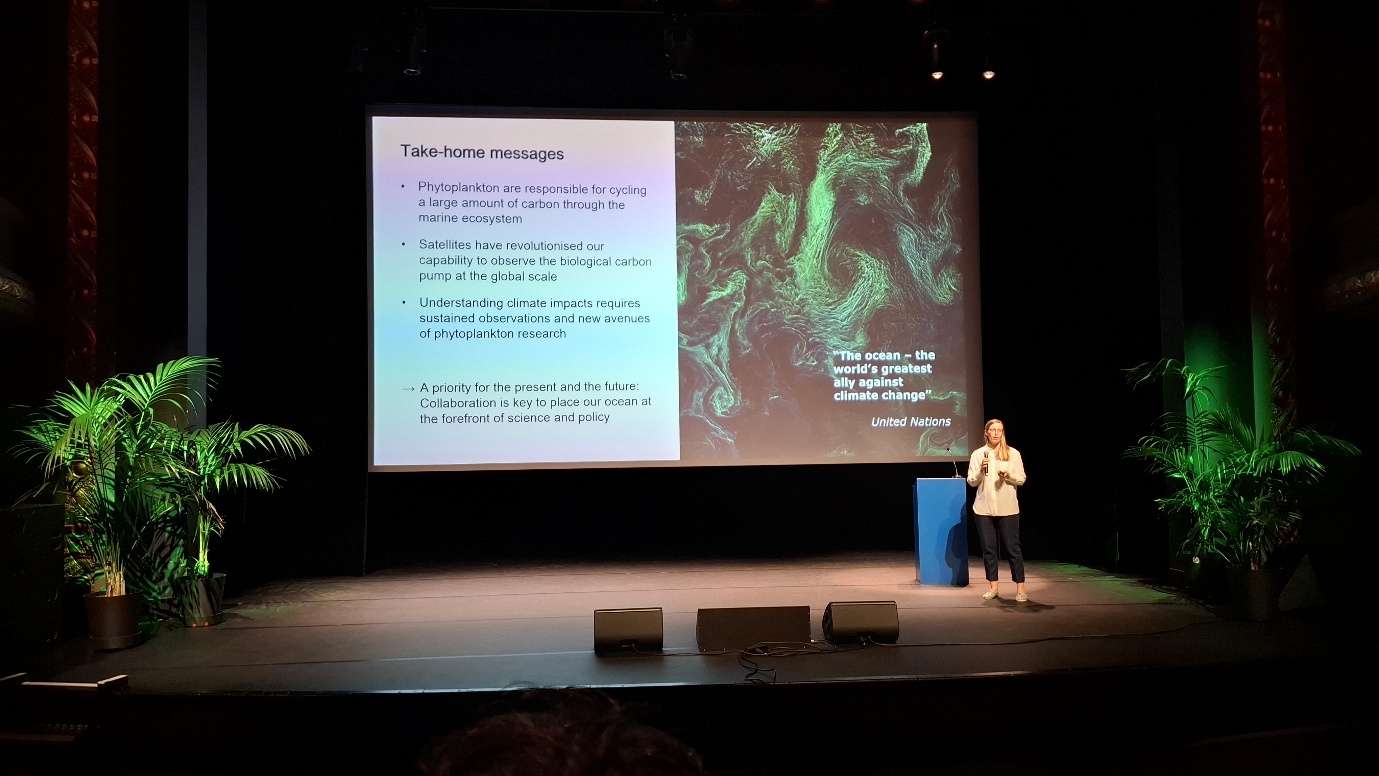
In the week of 14 September 2026, the SCOPE team attended the Ocean Optics XXVII Conference in Ghent, Belgium to share the latest scientific results of the project. This event brings together a diverse ocean optics community, including oceanographers, limnologists, optical engineers, Earth observation scientists, resource managers, and policy professionals from across the globe, all united by a shared passion for optics in aquatic environments.
Dr. Gemma Kulk was invited to speak on the role of phytoplankton in the biological carbon pump. She elaborated how nearly 30 years of ocean-colour satellite observations have transformed our understanding of phytoplankton and their influence on the global carbon cycle. Satellite data have enabled global monitoring of phytoplankton biomass and productivity, providing new insights into the biological carbon pump and the movement of carbon through the ocean. Outcomes of the SCOPE project were presented, specifically focusing on the ability to establish an ocean carbon budget from space and understand changes in the pools and fluxes that make up the ocean carbon cycle.
Dr. Mengyu Li presented her work on pathways of carbon sequestration in the North Atlantic Subtropical Gyre. By combining measurements of particulate and dissolved organic carbon with indicators of microbial activity, she showed a strong link between surface carbon export and long-term carbon storage in the ocean interior.
The results showed that particulate organic carbon contributes around half of total biological carbon export, while microbial processes transform dissolved organic carbon into long-lived forms that can remain stored at depth for extended periods. Her findings demonstrate the value of multi-platform optical observations for improving our understanding of the biological and microbial processes that regulate ocean carbon sequestration and the global carbon cycle.