
A major new study has revealed that longlived swirling ocean features, known as mesoscale eddies, play a role in modifying the absorption of atmospheric carbon dioxide (CO₂). They can last for months or even years and carry heat, nutrients, and carbon across vast distances. Although their physical impacts have been studied for decades, until now scientists lacked a global dataset of how longlived eddies influence air–sea CO₂ exchange.
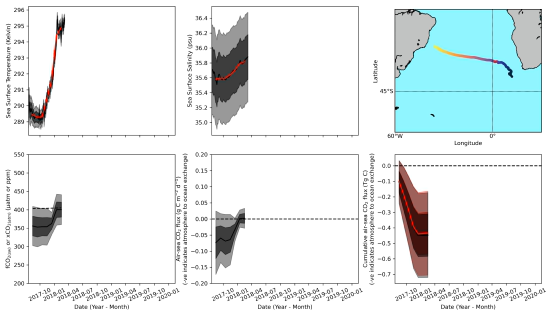
Daniel Ford and Jamie Shutler (University of Exeter) alongside colleagues from Plymouth Marine Laboratory created a dataset of 5,996 longlived eddies and their air-sea CO2 fluxes tracked between 1993 and 2022. The new dataset, named UExLEddies, was generated using a synergy of satellite, reanalysis and neural network techniques within a framework which enabled the researchers to estimate CO₂ fluxes within and around each eddy. The animation below shows the framework in action for an Agulhas current eddy, transiting the South Atlantic Ocean
Chl-a is an essential climate variable widely used to understand marine ecosystems, primary production, and the ocean’s role in the global carbon cycle. While satellite observations have enabled high-quality, long-term chl-a climate data records, they suffer from persistent data gaps caused by cloud cover and the absence of sunlight during the polar winter. These gaps present a major challenge for global climate studies, data assimilation, and machine-learning applications that require spatially complete inputs.
Individual long lived eddy showing the eddy trajectory and the collocation with satellite observations of sea surface temperature are shown on the top row. The fugacity of CO2 in the seawater (fCO2(sw)), the air-sea CO2 flux and the cumulative flux are shown on the bottom.
Using the UEx-L-Eddies dataset the study shows that mesoscale eddies typically enhance the air-sea CO2 flux into the ocean, but with regional and category differences. Anticyclonic eddies (“warm core”) were globally associated with enhancement of CO2 uptake of 4.5 ± 2.8 %, whereas cyclonic (“cold core”) showed a tendency to reduce CO2 uptake by 0.7 ± 2.6 %.
Regionally it was shown that for the Southern Ocean, anticyclonic eddies acted to enhance the CO2 sink by 5.7 ± 5.0 %, which indicated a stronger impact than the global average. Similarly cyclonic eddies were shown to reduce CO2 sink by 2.5 ± 4.5 %. These geographical patterns offer new avenues for understanding how climate change may alter eddy behaviour and, in turn, global carbon uptake.
Global animation of the UEx-L-Eddies dataset. Red outlined circles indicate anticyclonic eddies, and blue outlined circles indicate the cyclonic eddies. The circles are coloured based on their percentage modification of the air-sea CO2 flux.
A public dataset to accelerate mesoscale eddy research
The full UExLEddies dataset is freely available via Zenodo, enabling global researchers to:
- Investigate the physical/biological drivers of the air-sea CO₂ flux changes within eddies
- Investigate the processes that are occurring within eddies that could be drive modifications in the air-sea CO2 fluxes
- Assess longterm trends in eddycarbon interactions
- Integrate eddyscale processes into carbon budget assessments
These full dataset are available on Zenodo at: https://doi.org/10.5281/zenodo.15689876
This work was supported by the European Space Agency through the Satellite-based observations of Carbon in the Ocean: Pools, Fluxes and Exchanges (SCOPE) and Ocean Carbon for Climate (OC4C) projects. The study also contributes the Atlantic Meridional Transect.